This thought was partly inspired by a doom scrolling session where I encountered people bickering over what I felt was a stupid thing in what the process of one discarding what is not useful to them anymore is called.


This thought was partly inspired by a doom scrolling session where I encountered people bickering over what I felt was a stupid thing in what the process of one discarding what is not useful to them anymore is called.


Did the headline pique your interest?
I guess it’s not the obvious thing you hear. We’re told from a young age that a degree is a great option to unlock a field of opportunities. And this is certainly true for many of us, but it’s wise to remember it’s not a guarantee.
And it certainly pays to be wise with the spiralling costs of higher education.
The Education Data Initiative found the average cost of college in the United States is $35,551 per student per year, including books, supplies, and daily living expenses. Which means the average cost of college has more than doubled in the 21st century, with an annual growth rate of 7.1%.

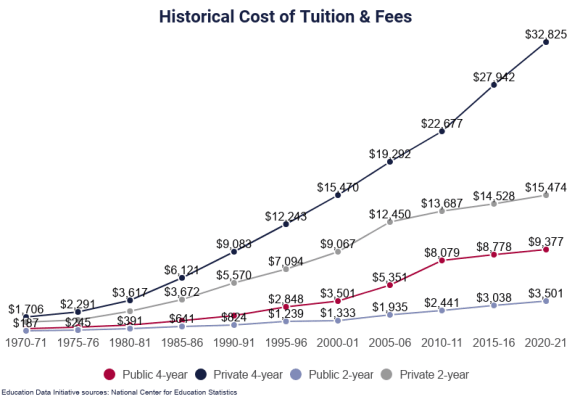
So, this thought is a mash of a few areas:
1) The disconnection of degrees.
2) Why more courses, accreditations and degrees aren’t the only answer for development (and I say most, as doctors, psychiatrists, lawyers etc need these for safety reasons).
3) Societies’ fixation on a model more linked to social status than one of benefit in a fast-paced and continuously adaptable environment.
Safe to say, these thoughts might get entangled.
But, I hope I can at least provide some value and even a bit of reflection on the way our world views the process of growth today.
Anyway, let’s get to it, shall we?
I’ve always found the notion of people believing growth and learning stop after formal education quite comical.
As if on one particular day, we decide that this is it. I’ve done all my learning now so I now need to never do such a thing again and should be awarded all the riches of life in accordance with the education I have received so far.
Usually, this happens when one completes their higher education studies in their mid-lateish 20’s. But it can happen at any time in our lifecycle.
We could look at this as finite thinking in what is mostly an infinite game. This is something I focused on a lot in my book on thriving and surviving a career in the 9-5.
Now, before we continue, I want to note that I’m not knocking the pursuit of formal education or degrees. For many, this is the right path and one that serves well. My goal here is to highlight the misconceptions of what this route can provide and what some people feel they are owed from it.
A degree is not a guarantee of anything or a debt that society owes any of us. It is, in many areas, what I like to call a ticket to the show.
In some way or another, my whole career has been connected with workplace people development in its now 16-year span. This has given me the wonderful and unique opportunity to meet brilliant people from all walks of life.
One commonality I have found amongst my connections with fellow humans is the way society has programmed us to look at educating ourselves and the status we are owed if we achieve x,y and z.
The words education, learning, and my most hated word of training are loathed by so many of us because of the experiences and untold amounts of pressure and stress that are placed upon us in our younger years to attain a certain level within a commonly agreed-upon system.
I meet many (including myself at one point) who breathe a sigh of relief when they leave any education system and enter the world of work.
Why? Because they no longer have to conform to an experience that does not serve them and forces them to do something which yields little enjoyment and sometimes value.
And that’s a shame, as the real shocker is that we don’t stop learning, ever!
The known international education systems today are not where learning and growth end. They’re merely a chapter in our story. And, like the wise Albert Einstein said “Intellectual growth should commence at birth and cease only at death.”
This is why I tend to find many are reluctant to engage in any form of workplace development that mirrors anything like education, learning or training in our minds. We’ve already formed a pretty divided opinion on those experiences before we set foot in the door.
Social learning, mentoring and coaching are popular methods of growth that haven’t been tainted with the experience of formal education. Even though all lead to the same outcome – our improved development as humans.
So, because of the bad rep education gets, in whatever context you view it, people tend to see their time served within these systems as some sort of badge they wave at the entrance of employers and social events to guarantee their status in society.
The funny thing is that life has other ideas.
We live in an area of the multi-career.
Many of us will change what we do several times during our lifespan. Opportunities to diversify and build new skills and behaviours have never been more accessible. We also have more of us than ever shunning what is viewed as “typical careers”.
Instead, we focus on becoming social media stars, gaming streamers and content creators in all forms.
It has never been more popular to not have a defined career. The non-obvious path has become obvious.
And you know what? That’s ok.
Our world is fast-paced, high delivery and full of pivot points where we need to adapt. Sadly our education system is not.
So still telling people that you have a degree in philosophy with a master’s in this and went to this university when you’re in your 40s as some kind of validation as to why you should be given a new role or promotion is not going to fly.
Today, what we need most are those who understand the skill of intentional and continuous learning.
As I said before, a degree is a ticket to the show. We need to continue to do the hard work and become the star of it.
On some levels what I’m saying here is that we can do better as a society in setting this up as the norm and making it part of the conversation when we talk about education in all forms.
Learning is an everyday behaviour and one we’re all engaged with more than we realise. And yes, learning can be fun too. It doesn’t need to involve classrooms, textbooks or stupid assignments. It can be over walks or a coffee conversation between others.
Anyway, what’s my point here?
Perhaps, my focus is on us to not put all our eggs in one basket and reject continuous growth (I get I’m probably preaching to the choir with most reading this).
Perhaps, it’s also recognising that a degree doesn’t equal an advantage or a divine right in the game of careers. It’s a ticket to the show but you still gotta put in the work.
Here’s a little story for you before we depart for the rest of our day.
Many years ago, I worked with a company that recruited 100 fresh graduates a year on a 2-year rotational scheme. Each had a degree. and even a master’s in some cases.
They had done what society told them to do. Get a degree and increase your earning potential. This is somewhat true depending on your profession.
Anyway, about those grads, how many do you think remained after the 2-year programme completion?
Go on…throw a number out there.
The answer is that 5% made it. Yes, really, only 5% were left after all was said and done.
And why was this?
Because a degree alone is not enough to succeed.
We need the full package. Adaptability, resilience, a thirst for continuous learning and the motivation to make things happen.
You may be done with school. But you can-and should-see the rest of your life as an education.
Bill Gates, Microsoft Founder
These are the traits I’ve seen in people who have become high performers in their domain by the measurement they use to define such success. No matter if they have a degree or not.
I tend to believe that if we focus less on one-time activities and hacks or quick routes, we’ll recognise everything we do is about moving forward and getting a little better. Day by day, challenge by challenge.
This feels like a good place for us to end, friend. I hope my non-obvious thinking might spark something in you.
Let me know your thoughts in the comments 👇
If you like my writing and think “Hey, I’d like to hear more of what this guy has to say” then you’re in luck.
You can join me every Tuesday morning for more tools, templates and insights for the modern L&D pro in my weekly newsletter.


Let’s talk about some things you can do to scale the level of your learning and performance function.
Explore the industry today to understand what the modern approaches across organisations of all sizes are.
It’s good to understand not only what’s working, but what’s not working too, and why.
When you walk into any new role or are looking to take a new approach to your function, you don’t need to reinvent the wheel.
Not only should you do external research, but you also need to get a view of the land within the organisation. It’s vital to understand what infrastructure is already in place.
At the end of the day, everyone who’s part of the company is here to perform to provide ROI.
That might sound awful but it’s true.
Getting clear on the company strategy will help make sure you’re focusing on the right things to affect performance and provide value.
Not just doing the same old because that’s what people expect.
I strongly recommend not to take the easy road of assumptions and siloed conversations behind closed doors with only the chosen few.
To get the real picture of what’s happening across your organisation today, you need to get out and speak to the people. Ya know, the ones who are doing the work day in and out. The view of just senior levels only plays a dangerous game of opinions.
And most opinions are biased and without data.
This is not helpful when trying to build a learning and performance function that wants to enable real value for its people.
A simple action you can take is just talking to people across the org.
Use questions to understand what they like about the culture of growth today, what they like, don’t like and how they approach growth in their time outside work.
Use a data-led approach to build a strategy that actually helps fellow humans get better every day. Not a function that acts more like a McDonald’s drive-thru and peddles the usual junk.
Now it’s key to note here, that this is not a TNA aka a training needs analysis exercise. Screw TNA’s! They’re a bunch of BS in my opinion. Asking people what they want generally turns out to be a wishlist of stuff that they don’t need.
Most of us don’t know what we need to know.
So yes, collect data but ask the right questions. What people want and want they need are often two very different things.
I love to experiment with new ideas and improve upon what’s already in place.
Now I recognise, that depending on the culture of your org and leadership team, it can be difficult to have the space to experiment and change things up.
If there’s one thing I’ve noted in my 16 years in this space thus far, it’s that orgs like the stability of the good old L&D function.
This stable framework in the corporate space is a spillover of the framework we’ve all experienced through educational institutions.
But, education and learning in the workplace are not the same thing.
Education has always been instructor-led, I speak, you listen format.
Whereas workplace learning is all about adult connections and conversations. Repeating what happens in the education world is not going to enable the same benefit in the world of work.
If anything, it’s going to damage it.
So look to try out new things, but also respect the things in place now and look to improve on these.
And, we must not forget, that in our experimentation it can be incredibly useful to connect and learn from the world outside learning.
I’ve always found synergy and learnt a lot from fellow humans in the world of tech, product and marketing.
Taking approaches and skills from this world for your development is essential in building yourself into a T-shaped modern learning professional (more on that in a blog post soon!).
Now I know learning technology is all the rage, but it’s not going to be your saviour.
Tech (like all things in life) can be valuable if used with the right intent. And intention is the key word here, folks.
Likewise, we should not fear tech either. It’s not going to replace you or your team. Unless you want it to of course!
Instead of me writing a bunch more, here’s something I wrote earlier covering a checklist on what to do before buying any learning technology.
The bottom line is to be intentional in anything you use in your tech stack.
It must have a purpose to fix a real-world situation. Not just we should do this because everyone else does this.
It’s easier than ever to create a digital learning tech ecosystem.
It’s actually really hard to connect with people on a human level and create meaningful experiences in the real world.
For me, that’s the real challenge today.
Again, I’m not proposing a silver bullet solution here.
Instead, this is all about continued exploration across the culture you find yourself in and striking the balance that works for your community.
If you like my writing and think “Hey, I’d like to hear more of what this guy has to say” then you’re in luck.
You can join me every Tuesday morning for more tools, templates and insights for the modern L&D pro in my weekly newsletter.

We’ve been telling each other stories since the dawn of time.
Some for entertainment. Others for social connection, and a lot of time, for sharing knowledge.
It’s not a radical new concept which can be turned into a flashy new tool or methodology by an education provider (although I’m sure they’d try!). I love nothing more than a good old story to inspire us to do something great, or, in some cases, put us into the sleep we so crave.
We connect through stories.
I’m a big believer that good stories entertain people, but great stories change people.
Without great storytelling skills, I wouldn’t be here writing these words or working with global brands. That might sound braggy, but it’s not my intention.
It doesn’t matter how great your product, project or career is if you can’t tell a compelling story about it.
In the spirit of ‘paying it forward’.
Here’s what I’ve learned from the last two decades of conferences, TED Talks and many meetings. Plus, some human characters who embody the best skills.
The stories (or should I say PowerPoint presentations) I disconnect with most make no effort whatsoever to understand the audience.
You know, the ones where someone just talks at you like you’re an emotionless wall built for the sole purpose of receiving noise.
This is often seen in the world of workplace education.
Many are misguided by the sage on the stage persona, where L&D people are some sort of all-knowing gurus preaching their vast knowledge to their flock of disciples.
Telling people concepts off a slide is not enough. We have ChatGPT to fill that activity these days.
Instead, we must show the practical application of a topic.
This is where the magic happens.
You have to relate to people, their problems and their motivations. Weirdly, workplace learning has bred this quasi-education like approach of the parent-child relationship. This stops you getting key ideas and helpful messages seen, heard and valued.
Connection is hard to craft when you act like a preacher or teacher, and much easier when you step forward as a guide.
Guides empathise with the audience. They share common challenges, and break through them with useful data and insights that invite the audience to explore together.
→ They create connection.
This applies to everything from public speaking to blogs, resources, podcasts and books too.
Here’s a practical example I feel embodies a lot of what I just shared.
This one comes from my own field of the learning industry with Nick Shackleton-Jones, author of How People Learn, Ex-Chief Learning Officer of Deloitte and all-around cool human.
I’m a fan of Nick’s work in all formats and his ability to tell stories in all settings sets him apart from quite a few in the industry (as does his ability to throw marshmallows at crowds).
This talk showcases a lot of what I’ve referenced above.
Outside of L&D, before he seemed to be everywhere, I enjoyed listening to a not so well known entrepreneur called Alex Hormozi.
Quick story behind this video. I changed 70% of my talk at the Learning Tech conference in 2022 4 days before the event because I watched this.
Alex’s slides were boring and basic, but his storytelling was AMAZING.
That’s what counts, and I learnt tons about pacing alongside audience connection.

A hallmark of great storytellers is the ability to turn complex ideas into simple tales.
I always think if you can’t explain it to a 5-year-old, you need to go back to the drawing board.
That always gets people taking a moment to pause and think.
We’ve all read, watched or listened to something with someone who’s an expert in their field, but terrible at their delivery of ideas. Often leaving us in a state of WTF!
This is a real shame, as we lose out on what could be valuable know-how.
It’s an art to take complex ideas and break them down into easy to digest and relatable stories.
Not only that, if you can educate and inspire at the same time, then you’re in the superstar leagues.
I’ve only come across a handful of people who do this really well.
One of those is the fabulous Brene Brown, a research professor at the University of Houston, and a visiting professor in management at the University of Texas at Austin McCombs School of Business. Spending the past two decades studying courage, vulnerability, shame, and empathy.
I love Brene’s work, and it has influenced so much of my own. Brene’s tagline “Maybe stories are data with soul” strongly connects with me.
If I could give you only one resource to learn from Brene’s approach, it would be her Netflix special released a few years back. Her storytelling awesomeness is in full flow.
Check out the trailer below, and if you don’t have Netflix, you can find plenty of Brene’s other talks on YouTube.
![Brené Brown: the Call to Courage | Official Trailer [HD] | Netflix](https://i0.wp.com/i.ytimg.com/vi/gr-WvA7uFDQ/hqdefault.jpg?w=580&ssl=1)
I’m sure you’ve heard talks that sound like a scripted interrogation rather than an informative masterpiece.
Often, people don’t want to come across like this.
They’re just scared people won’t like who they really are. If you’ve met me IRL or consumed any amount of my work, you’ll know I’m the antithesis of the 9-5 corporate stereotype.
I come with a cargo ship worth of witty comments, memes and GIFs to unleash on unsuspecting listeners at any moment.
Yet, I’m not everyone’s cup of tea.
That’s fine. However, this is me.
This is something I really struggled with in my early L&D leadership career. I spent a lot of time telling myself in meetings “Whatever you do, just don’t be you and we’ll be cool”.
How misguided that was.
What I suppressed actually gave me an ‘edge’.
I led myself to believe that I had to fit a view that others expected – Basically one of a corporate robot.
3 things changed this in my career:
No one wants a corporate robot that looks feels and talks the same as everyone else.
Realising this made me 100x better at what I do. It was my edge in a crowded market. You can’t please everyone and you shouldn’t aim to. This is the foundation of how I’ve built my business too.
I infuse my approach and personality into everything from writing to videos.
Someone who I feel showcases what I’m talking about here, and navigates it very shamelessly, is Professor Scott Galloway of NYU Stern Business School.
Like me, he’s not everyone’s cup of tea. But he embraces that.
He’s authentic and conveys this (mostly) in a way that’s positive and exemplifies his work.
I recommend you check out this video to get an example of what I mean ↓

We seem to lose this along the way in all aspects of life.
The world can be too serious, and not so serious at the same time.
Being playful allows you to bring character to many topics. You can deliver playfulness through what you say, imagery and suggestion. I’ve learnt a great deal about playfulness over the last few decades from writer Tim Urban.
Tim has one of the most popular blogs on the digital highway called Wait But Why.
With its deep and often very long articles covering life, love, careers and human existence. It has very much served as an inspiration in my own creation of Steal These Thoughts.
Tim’s storytelling works so well because it’s relatable, playful and at the same time transformational.
He covers deep meaningful topics with a unique personal lens of humour and stick man drawings. Much like I’ve adopted gifs, memes and British sarcasm as mine. These components are not just playful, they’re relatable.
Similar topics would not be out of place in an HBR, New York Times or Wall Street Journal.
The delivery is the difference.
Some of my favourite posts of his include:
He has a thrilling Ted Talk on beating the procrastination monsters which demonstrates all this in a visual format too.

Outside of my lessons, I’ve found these tools and frameworks incredibly useful too.
I don’t think a mythology writer imagined their work reshaping storytelling frameworks.
But that’s what happened to Joseph Campbell with his ‘Hero’s Journey’ formula. You might not have heard of Campbell or this framework. Yet, I guarantee you’ve been a recipient of it.
Ever seen a Disney, Star Wars, Marvel, The Lord of The Rings, The Matrix or just about any film, tv show, video game or book like this?
Then you know the Hero’s journey.
Long story short, Campbell observed that stories across all cultures share a similar structure, one he called the ‘Hero’s journey’.
There’s always a person forced into a call to action, which they don’t want, where they must face challenges to grow stronger, and then return to the world to use this newfound wisdom/powers/skills to complete their transformation.
As an example in the film, The Matrix:
Neo, a hacker, is contacted by Morpheus, who offers him a choice between the red and blue pill, signalling a path to discover the truth about the Matrix.
Neo is initially hesitant. Unsure if he can trust Morpheus or handle the truth.
Neo takes the red pill, waking up in the real world and leaving behind his ordinary life.
He faces challenges, such as learning to fight in simulations, and encounters allies like Trinity and enemies like Agent Smith. Neo begins to believe in his potential as “The One” but doubts still linger.
Neo confronts Agent Smith and is killed in the Matrix, but through his belief and love for Trinity, he is resurrected.
Neo realises he is “The One,” gaining full control over the Matrix and his abilities. He continues to fight for humanity, but now with the confidence and understanding of his powers.
Neo fully embraces his role as humanity’s saviour, transcending his limitations. He returns to the Matrix, now empowered to lead the fight against the machines, with the knowledge that he can change the Matrix and free humanity.
The call to action begins when Harry learns he’s a wizard and attends Hogwarts.
With Professor Dumbledore as his mentor, he enters into the magical world, facing challenges like friendship, enemies like Draco, and the growing threat of Voldemort.
His Trigger Point is the repeated confrontations with Voldemort, culminating in the final battle. After defeating him, Harry experiences Transformation and returns as the hero who brings peace to the wizarding world, completing his journey.
You get the picture.


This framework isn’t exclusive to the creative realms.
I’ve used this same framework to tell stories about L&D programmes, career progression and the success of learning platforms.
The formula is simple:
Let’s put this into action with an L&D focus:
Your L&D team has just been given a monumental task.
You need to up-skill the company on a brand-new learning-focused AI platform. The powers that be (your senior execs) have decided AI is cool and sexy and the business needs some of it. The call comes to you as the lead to make this happen.
But, you don’t want any of it and you don’t know how to make this work, either.
Suddenly, as with any great story, a guide/mentor appears.
Maybe it’s a consultant, a vendor, or a colleague who’s been through it before. They share their knowledge, their tips, and their confidence. Suddenly, the path forward becomes clearer.
Before you know it, it’s all happening and there’s no turning back. But, of course, nothing worthwhile is ever easy.
Challenges start popping up everywhere.
Employees are resistant to change. Stakeholders demand ‘more interactivity’, and finance are losing their minds over the cost of training all employees. Plus, time is always against you when you need a year to deliver but the execs gave you two weeks.
Yet, amidst all the problems, you find your friends.
That one senior manager ‘gets it’. Early adopters get excited and start to champion the workshops. You begin to build momentum, even as more obstacles keep coming.
Then it’s here.
The programme is live, and the first feedback starts rolling in.
You have raving fans and haters, that’s just how it works. But the journey isn’t over.
There’s more work to do, refining the programme, gathering feedback, and making sure it evolves with your company’s needs.
As time goes on, the early challenges fade
New ways of working just feel like the way things have always been. You and your team have come out the other side stronger, with new skills and expertise that will carry you forward.
Collectively, you’ve faced the fire, learnt a lot, improved your skills and are now a stronger human.
Now, doesn’t that sound more exciting than an ‘everything on a slide’ PowerPoint deck?
Of course, you can use data, visuals and key insights to back up this story. The point is, that anyone can chuck content onto a bunch of slides, but very few can craft a compelling story.
→ Be the latter.


With storytelling, you need different approaches for different audiences.
Where the ‘Hero’s journey’ might be great for your local team meeting. I doubt your senior execs will be as excited. So we need to adapt.
A framework I’ve always liked comes from famed McKinsey consultant, Barbara Minto.
I like it for the very simple reason you get the answer or solution to the problem upfront.
For those of you who have been part of exec meetings, you know how important this is. You’re often thrust into a gladiator type arena where you have only minutes to make your case.
A novel on the struggles and pains of L&D won’t work here.
It’s pretty straightforward.
1/ Start with the Answer: Lead with your key message or conclusion. This helps your audience understand the main point immediately and saves the death eyes from several execs.
2/ Support with Key Arguments: Provide 2-4 main reasons that support your answer. Each argument should be distinct and logically sound.
3/ Provide Detailed Evidence: After stating your arguments, go deeper by presenting data, examples, or analysis that back up each point. This gives your audience the “why” behind your answer.
In sum: Start with your conclusion/answer, then outline the key reasons that support it, followed by data or deeper analysis.
We’ll end our storytelling journey here folks.
In sum:
A live break down of my storytelling framework.

If you like my writing and think “Hey, I’d like to hear more of what this guy has to say” then you’re in luck.
You can join me every Tuesday morning for more tools, templates and insights for the modern L&D pro in my weekly newsletter.


Knowing how to build the right skills is not as easy as one might think…
In a world of bloated centralised content catalogues that mostly promote decision fatigue. The aspiration of the self-led learning movement at scale is quite difficult to achieve.
Why so?
Simple really. Many of us don’t know what we need to learn.
And, even when we do, knowing what resources will actually help us in the quest to build a skill is not so clear-cut.


→ Tools and frameworks to improve performance through tech
→ Case studies from leading L&D teams
→ In-depth breakdowns of the skills you need to succeed.
4,000 L&D pros love it ❤️
