Categories
Artificial intelligence

5 Insights That’ll Challenge Everything You Think You Know About AI In L&D

When I think about the future of learning with AI, I don’t imagine it as more content and courses.

A rewiring of what we do and how we do it is here.

While most teams are stuck at the point of innovations from 2 years back, you can be ahead of this. Perhaps, this is the new reality of learning in the flow.

Conversational, not transactional.

I can’t help but get excited about conversational-driven experiences that not only develop new skills but also reveal more about ourselves and how we think.

Yet…I still see a lot of talk and not so much action, sprinkled with a lot of misinformation and actual understanding of Gen AI’s power and limitations. That creates a problem if the L&D industry wishes to thrive in the new world of work with AI.

Here’s 5 insights I’ve picked up in my research, analysis and partnering with lots of L&D and HR teams over the past few years on driving AI adoption.

A graphic illustrating 'The Customer Experience' featuring logos of various AI tools: Gemini, Copilot, deepseek, ChatGPT, and Claude, arranged in a circular flow, emphasizing that LLMs are the new operating system.

1/ Your customers are building their own solutions

The biggest problem, in my eyes right now, is the fact that our audience (I’m not calling them learners!) is able to design their own personalised and adaptive learning experiences with LLMs.

Whether they’re good or not is another question.

I’ve been talking to clients about this for the past year. They mostly nod and reply ‘that’s interesting’, but it’s more than interesting. It’s a threat coming right down the barrel at light speed to many L&D teams.

Why do they need you, if they have the gods of LLMs?

(I shared a post on this a few months ago: How will you respond to the changes in your customers’ experiences?)

We must ask ourselves, if our customers have access to intelligence on-demand and personalised learning experiences, how do you fit into that?

You cannot fight the adaptiveness and personalisation that generative AI enables.

That would be a foolish endeavour. Instead, you have to evolve as workforces will demand a new level of experience that they currently enjoy in their personal life.

We’ve been here a few times before.

As an industry, we’ve lost many battles to Google search, all of social media and YouTube.

We all want the sleek experiences from our personal use, end of story.

So, this presents a crossroads for us.

Either we keep trying to force people to places and spaces they don’t want to be, or design to meet them where they’re hanging out. The choice is yours.

If we look at AI as the dominant emerging operating system, you have your answer to the above.

Cartoon depicting a dog sitting calmly in a burning room with the caption 'THIS IS FINE', illustrating the misconception that AI adoption is merely a training project.

2/ It’s a transformation, not a training project

I find so many teams fail to see this.

AI in L&D is not your latest training project, it’s one of the biggest transformation projects we’ll ever face.

And…one we need to consider if we exist at the end of it in our current form (so controversial, I know 😂).

If you’re reading these words and all your team/company is doing is the minimal “Let’s train everyone how to write prompts”, then check out this post where I walk through the 4 levels of transformation happening across L&D with AI right now.

TL;DR: Stop treating AI adoption like a training project

3/ You can do a lot more with AI today than you think

You know I share a lot of innovations and tech demos.

What some don’t realise is that almost everything I share is available to use right this minute.

That’s why I’m always surprised when I get weekly messages like “I had no idea this was even possible today” or “OMG! I thought this would be years away”. Remember when I said about teams being stuck at innovations from 2 years ago, this is what I mean.

The most recent example of this is when I shared a video of me working with an interactive avatar from HeyGen.

It’s basically a face and voice on top of an LLM. No static avatars or scripts to read from.

My inbox went mental once more, and it proved to me again that there is so much untapped potential with current technology.

So many miss all of these innovations because they’re too busy chasing all the shiny things!

You can find even more innovative ways to use AI to rewire L&D on my YouTube channel and on the dedicated AI for L&D section of the STT website.

Speaking of chasing shiny things…

4/ You’re trying to sprint before you can walk with AI

Agent this, agent that is literally all I see on LinkedIn these days.

Granted, it’s a total echo chamber of people mostly shouting that back at each other, but by God, it’s giving me a headache.

The hype, mostly driven by AI companies, is becoming laughable.

Don’t get me wrong, AI agents will be very useful and there’ll be some great applications in L&D, yet you’d think a sort of world peace is about to emerge by the way the ‘influencers’ talk on social.

I work with sooo many teams and companies that hardly know how to use a basic AI assistant to even 50% of its potential. Adding agents into that mix is a recipe for both confusion and mistakes.

A humorous meme featuring two characters discussing the term 'AI agent,' with one expressing skepticism about its meaning.

A lot of people need to slow down

Pause… take a breath and find your centre (or whatever meditation teachers say).

Almost 90% of what you see paraded online is not a true agent solution. Not in the technical context, anyway.

Much like marketing teams decided to use the word “AI” everywhere post-2022, they’re doing the same thing by labelling everything an Agent.

Unfortunately, this has created a fractured understanding of what an agent is, and the definitions are always changing.

So, I decided to put something together to cut through that BS ↓

5/ Using AI for conventional “learning” tasks is not groundbreaking

Perhaps this is a controversial one.

I don’t believe using AI tools to do more of the conventional content and course experiences in L&D is an impressive ‘use case’. Whenever someone says to me, “I used ChatGPT to create my next course in half the time,” I chuckle in my head ‘That’s cute’.

You can use it to produce more courses and content, but where does that get you?

The same place where the 99% who could become obsolete occupy.

I keep using the word “rewire” so much in my work because that’s what we need – a complete rewiring of what we do and how we do it. Be brave enough to say, “Does this need to be a course?”

With intelligence on-demand in everyone’s hands, our default operating system is becoming AI, and it’s not using courses to help people learn.

I know I keep saying it, but you don’t want to use AI to accelerate outdated ideas and practices. Instead, we should focus on rewiring what we do.

This quest of rewiring what L&D can do with AI has led me to think of a world beyond the course or event as the default delivery for learning moments.

I share one of those experiments in this one ↓

Final thoughts

There you go, friend.

Now you see what I see, and my hope is for you to use this to improve your work both with AI and if you’ve been given the ill-fated L&D mission of “making people use AI”.

→ If you’ve found this helpful, please consider sharing it wherever you hang out online, tag me in and share your thoughts.


Before you go… 👋

If you like my writing and think “Hey, I’d like to hear more of what this guy has to say” then you’re in luck.

You can join me every Tuesday morning for more tools, templates and insights for the modern L&D pro in my weekly newsletter.

Categories
Artificial intelligence

An Unconventional Way To Learn New Skills with AI

I often see the spread of AI across L&D like a game of 4D chess.

It looks complicated, but it is simpler than you imagine and requires a depth of thinking beyond the status quo.

I know I keep saying it, but you don’t want to use AI to accelerate outdated ideas and practices. Instead, we should focus on rewiring what we do.

This quest of rewiring what L&D can do with AI has led me to think of a world beyond the course or event as the default delivery for learning moments.

I’m going to share one of those experiments with you today.

Reverse-engineering with AI

As I become older, and allegedly wiser, I can’t help but keep asking – why did I do that thing?

That thing can be anything.

A purchase, a quick decision, a random Tuesday afternoon choice on which delicious tea to drink.

It’s probably why I ended up in L&D.

I always want to understand what makes people do what they do. Plus, the biggest goal of any L&D function worth its salt is to understand and influence behaviour.

Every time you’re asked to deliver “training”, it’s an ask to change behaviour.

Anyone who’s worked with me will know I ask questions, a lot of them.

I could be classed as either a psychologist or an FBI interrogator, based on the context of my deep line of questioning.

I’m not scared to turn this on myself either.

I know that sounds like some weird scene from The Matrix, but stay with me. I felt like this could be a great opportunity to do a little experiment with AI to engage in a bit of an unconventional learning strategy.

I also like to think of it as a “looking beyond a course” solution, because everything doesn’t need to be a course, ya know.

The email made me do it

Like you, I get a lot of messages about products and courses.

I skim a few and delete a lot.

There was one I’d be going back and forth with for about 6 – 8 months. It was about copywriting, which is an essential skill for all humans, imo. Even more important in my line of work with getting people’s attention and turning the complex into something simple to understand.

I’d seen lots of emails about the course.

I read the reviews and thought a lot about it. But still didn’t find my way to the “buy” button.

That changed in one afternoon.

One email about the course, which offered a limited-time discount, hit me at the right time, and I threw my money at it. A few hours later, I wondered what about ‘that email’ made me take the final step.

I’d seen numerous emails about the course over the past 6 – 8 months, but I did nothing.

That got me hooked…and slightly obsessed.

I think we can learn a lot from decisions like this. Not just about ourselves, but the techniques that others use to influence behaviour. This email could do both.

So, I decided to reverse engineer the email with the help of AI, as my coach.

This is an experimental learning experience, and you can see the results in the video below.

What you can take from this to transform your learning experiences with AI

What I’m sharing here is not conventional, not by workplace learning standards.

Most workforces view a “learning experience” as a form of content delivery, either by being in a room with others or consuming a static digital product.

That might have worked pre-2022, but we’re firmly in the realm of conversational experiences.

This opens up a new level of self-exploratory learning (not sure that’s a thing, but whatever) that doesn’t require a classroom or a course.

Here’s a few thoughts on why this approach is beneficial to both you and the people you serve:

1/ Focus on the ‘Why’

I strongly believe we don’t ask “Why” enough.

We used to do it all the time when we were young to help us understand the world we’re growing up in. Somewhere along the way, we lost our confidence to do that.

I think both school and the workplace make us scared to ask simple little things like “why” and just say “I don’t know”.

You’ll see in the video how I use AI to claw out the focus on ‘why’.

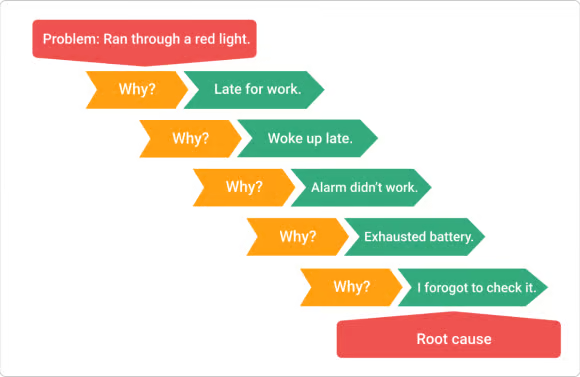
It reminded me of the useful decision-making framework called the “5 Whys”, which was created by Sakichi Toyoda at Toyota. It was so effective, it became part of Toyota’s much-loved “Lean Philosophy”.

The goal is to find the root cause of a failure, challenge or behaviour.

It’s so simple you might be tempted to discount it, but you’ll be surprised by its results. All you do is take the problem or challenge you’re obsessing over and ask ‘why’ 5 times.

Here’s an example from Kabanize.com

In a way, I feel like AI can re-ignite some of our childlike wonder through conversational experiences.

As a child of the 90s in a pre-Google era, most of my fascination and curiosity were satisfied through the children’s book series of “How Things Work”.

Now, I use AI and moments with humans to navigate that same curiosity.

2/ Leveraging AI as a mind coach to uncover unknown perspectives

That title sounds vastly more sinister than what I’m trying to get at.

Sometimes my engagements with AI can feel like talking with a parrot, and at others, I feel like I’ve met a digital Buddha with profound insights.

When it comes to reverse-engineering ideas, processes or anything, I find this style of conversation more rewarding than watching a presenter slowly murder my attention span with PowerPoint.

One of my favourite lines of convo with my local LLM of choice is “What am I missing here?”

I’ve had some wild revelations from that question alone.

3/ Skill Exploration

No one knows everything, nor do they have all the skills in the world.

Life isn’t some Marvel film where some angry guy is travelling the world collecting skills for their evil or not so evil plans. That doesn’t mean you shouldn’t be curious about other skills and how they are used.

This is the exact thing that led to my analysis and reverse-engineering experience shown in the video.

I want to understand why I took an action, but I also want to learn how to craft such a skill myself in copywriting. As we become ever more focused on skills, I can only imagine this being a meaningful way to support people in developing the right skills.

Final thoughts

When I think about the future of learning with AI, I don’t imagine it as more content and courses.

A rewiring of what we do and how we do it is here.

While most teams are stuck at the point of innovations from 2 years back, we can be ahead of this. Perhaps, this is the new reality of learning in the flow.

Conversational, not transactional.

I can’t help but get excited about conversational-driven experiences that not only develop new skills but also reveal more about ourselves and how we think.

→ If you’ve found this helpful, please consider sharing it wherever you hang out online, tag me in and share your thoughts.


Before you go… 👋

If you like my writing and think “Hey, I’d like to hear more of what this guy has to say” then you’re in luck.

You can join me every Tuesday morning for more tools, templates and insights for the modern L&D pro in my weekly newsletter.

Categories
Artificial intelligence

Everything You Need To Know About AI Agents For L&D (2025)

Agent this, agent that is literally all I see on LinkedIn these days.

Granted, it’s a total echo chamber of people mostly shouting that back at each other, but by God, it’s giving me a headache.

The hype, mostly driven by AI companies, is becoming laughable.

Don’t get me wrong, AI agents will be very useful and there’ll be some great applications in L&D, yet you’d think a sort of world peace is about to emerge by the way the ‘influencers’ talk on social.

So, this is my PSA (public service announcement) to you to say: “Don’t get worried about all the talk.”

I know it feels like you’re missing out on some great party, but you’re really not.

Don’t believe the AI Agent hype in L&D

Almost 90% of what you see paraded online is not a true agent solution. Not in the technical context, anyway.

Much like marketing teams decided to use the word “AI” everywhere post-2022, they’re doing the same thing by labelling everything an Agent.

Unfortunately, this has created a fractured understanding of what an agent is, and the definitions are always changing.

Not only this, but many are trying to run before they can walk.

I work with sooo many teams and companies that hardly know how to use a basic AI assistant to even 50% of its potential. Adding agents into that mix is a recipe for both confusion and mistakes.

A lot of people need to slow down

Pause… take a breath and find your centre (or whatever meditation teachers say).

Without this moment of pause, it’s incredibly hard for you to truly know what’s going to help you and what you don’t need to know.

And too many of us aren’t aware of all the options we already have today.

Agents are cool, but the current noise is lying to you about a lot of things.

So, let’s bring some clarity to all of this ↓

A scene from a film featuring two characters, with one expressing confusion and disbelief about the term 'AI agent,' while the other looks perplexed.

Assistants vs Agents: What’s the difference?

Two terms you might hear techies mention with AI products are ‘AI assistants’ and ‘AI agents’.

Here’s the difference in clear, simple terms.

Let’s start with what we know – AI assistants like ChatGPT.

These are tools that help us with tasks through conversation. They can write, analyse, explain, and give suggestions based on what we ask.

AI agents take this a step further.

Instead of just helping through conversation, agents can actually complete tasks on their own. They follow instructions, use different tools, and make basic decisions to get things done.

The key difference is simple:

  • AI assistants help you with tasks
  • AI agents complete tasks for you

Both are valuable, but they serve different purposes. An assistant works with you through conversation, while an agent works independently based on your instructions.

Use this info to impress the boss at your next meeting.

I’m not going to leave you with just this, though.

As I’m a tech nerd, I’ve filmed a quick video (see below) to show how agents work with examples from Google and Salesforce – enjoy.

What can AI agents do?

A lot, but maybe not as much as the local tech bros are promising.

Imagine having a personal assistant who not only follows your instructions but also takes the initiative to resolve problems independently.

AI agents are like that, except they exist in the digital world.

At their core, they’re designed to observe their environment, make decisions, and take actions using the tools available to them.

Unlike traditional software that waits for you to give it a command, like LLMs, AI agents can think ahead, figure out what needs to be done, and act.

Sometimes without needing constant human input.

Think of them as a self-driving car.

Instead of waiting for a person to steer, brake, or accelerate, the car analyses traffic, makes decisions, and moves safely toward its destination.

AI agents work similarly but in a digital space, whether it’s automating workflows, analysing data, or even assisting with creative tasks.

The magic of AI agents lies in their autonomy and problem-solving abilities.

Even if you don’t give them step by step instructions, they can work out the best way forward to achieve a set goal.

They do this by following set rules and past experiences to decide the best way to complete a task. This makes them incredibly useful for businesses, customer support, research, and even personal productivity.

→ Get an example of this type of AI agent solution with this scenario I built to support common onboarding challenges between HR and Tech teams.

The many faces of AI agents

There was a time when an AI agent meant one thing.

Now, we’ve hit peak confusion thanks to marketing teams the world over.

Each one wants to tell you they’re “agentic”, and each wants you to use their AI agent. But…is it really an AI agent? And if it is, is it the right one for you?

Let’s unpack the types of AI agents, or what social media wants to tell you are AI agents in the market today:

Now, the reality of what you see online is 95% in the automation and AI workflow buckets.

I know every 22-year-old with a YouTube channel wants to tell you otherwise, but “true” AI agent solutions, right now, are rare. Even rarer are agents doing valuable work within organisations.

And when I say ‘agents’, I mean actual ‘agents’, not workflows.

I’m not being harsh. I think AI workflows and automations are very useful, just don’t call them “Agents”.

Before we move on, let’s talk about Model Context Protocol aka MCP, in the first image.

Unless you’re a backend developer or some super nerd (like yours truly), you might never engage with MCP. Nonetheless, let’s take this as a learning moment to once again impress at your next team meeting.

Model Context Protocol Explained

To understand MCP, we need to understand the limitations of Large Language Models (LLMs) on their own, with the challenges developers face when trying to make them useful.

Maybe this will make you feel a bit of empathy for your local tech team.

LLMs are good at tasks like writing text, answering questions based on their training data, or generating code snippets.

However, they can’t do anything meaningful in the real world on their own, such as sending an email, interacting with a calendar, or performing a specific task on your behalf.

So, we need to connect them to different tools and services.

We can do this through APIs…however, this relies on APIs being made available for applications to connect and constantly needing to be monitored. One API with an LLM is easy, but connecting multiple tools to LLMs through APIs is difficult.

Now, MCP helps solve this problem by acting as a universal translator to simplify these connections.

Think of it as a layer between the LLM and all the different tools and services it might need to interact with. Instead of the LLM having to learn and manage every single service (through an API), MCP translates the different “languages” of all those services into a unified language for the LLM.

Now, either you got that, or I confused the s**t out of you.

If the latter, check out this vid, which should resolve that.

To Agent or not to Agent, that is the question

Every tool has its time and place.

I say that too often. Much like LLMs, and AI in general, Agents aren’t the answer to everything. Knowing when (and when not) to call upon the powers of an AI agent is a skill in itself.

My best advice is actually stolen from an engineer at Anthropic (creator of Claude).

Barry Zheng (Applied AI team at Anthropic) gave what I class as a legendary answer to the growing trend of people trying to apply agents to every problem, even when simpler systems would suffice.

“Don’t go after a fly with a Bazooka”

Barry Zheng (Applied AI team at Anthropic)

Magnificent!

I see this so much these days with a lot of tech.

So many tasks can be done in a few minutes by a human, but we’ll spend hours trying to get AI to do it. Surely, that’s counterintuitive to the goal?

Barry also shared this useful slide from one of his live talks (if you’re reading this, Barry, I’m not stalking you – promise!).

And to echo what Quentin Villard shared on LinkedIn, here’s a quick framework to figure out the best tool for the job:

  • If a task requires interacting with external services or your digital environment and is not set up as a workflow or agent, you need to do it yourself. Use a degree of common sense here. If the task is simple or you enjoy it, use that supercomputer in your head, aka the brain.
  • Choose an AI workflow for repeatable, rule-based tasks where you want predictable automation.
  • Choose an AI agent for tasks where you have a goal and want the AI to dynamically figure out the steps, acting as a flexible assistant.

Final thoughts

Of course, there’s much more to say about agents.

But for 95% of the humble humans in this world, this is what you need to know.

This space will continue to grow faster than my cups of tea can brew, but that doesn’t mean you need to be flying at the same speed.

Deep and meaningful understanding requires a moment or two to breathe.

Agents are here, they’re useful, and it will only become easier to access them in shared marketplaces.

As a bonus, here’s a few more resources to shape your knowledge:

Go forth, human.

→ If you’ve found this helpful, please consider sharing it wherever you hang out online, tag me in and share your thoughts.


Before you go… 👋

If you like my writing and think “Hey, I’d like to hear more of what this guy has to say” then you’re in luck.

You can join me every Tuesday morning for more tools, templates and insights for the modern L&D pro in my weekly newsletter.

Categories
Artificial intelligence

How To Build An Interactive AI Avatar (And 4 Ideas To Use It in L&D)

Ok, we’re getting super practical today.

Too much content talks about ‘what could be’, but you know I like to take a different approach.

I’ve always been a show, not just tell type of guy.

If you want to shape the future of the learning industry and expand your career, you gotta be down in the action. This is the kinda stuff you’ll never see at a conference.

Today, you’ll learn how to create your own interactive avatar and put it to the test as part of the evolving learning experience with tech.

Now doesn’t that sound fancy…

Before we begin, let’s get clear on why we’re doing this.

A few weeks back, I shared this video on LinkedIn. I honestly thought most people knew about this tech. It’s been around for at least a year.

Turns out I was wrong.

A lot of people freaked out. They either thought I was some sort of dark wizard or the whole thing was staged with a scripted avatar. Neither is true, and you’ll see for yourself today.

To get the most out of today’s edition, you’ll need to do a bit of reading, watching and doing.

Lucky for you, I’ve structured this all in the window you’re currently staring at.

Comparison of Standard AI Avatars and Interactive AI Avatars, featuring a woman with a serious expression on the left and a smiling expression on the right, with text labels highlighting their differences.
How ChatGPT sees the difference

The different levels of AI Avatars

Comments on my LinkedIn post tell me I need to provide some context on the current state of AI avatar technology.

So, let’s break down the difference between an interactive avatar and a standard one.

Let’s start with ‘what you know’…

Your standard AI Avatars.

The ones you’ve probably seen everywhere the past few years. You know the score with these.

You pick a character, a voice and give it a script to voice over your terrible elearning project…oh, sorry, I misspoke…I meant your content 😈.

Anyway, this is what you probably use and know.

In L&D, I’ve often seen Avatars used as a way to elevate bad practices.

Too many turn that already crap course/powerpoint/pdf into a droning avatar and think that’s ‘job done’. In reality, its just crap in → crap out.

That’s not the fault of the tech – it’s ours.

→ We are falling to the limits of our ideas.

Like with any product, it has good use cases if designed well.

Now,Interactive AI Avatars are the opposite of this.

There are no scripts.

Yes, you still pick a character and a voice, or clone yourself if you’re one of the vain among us, but that’s where the similarities stop.

An interactive avatar runs on two sources:

  • A Large Language Model (LLM)
  • A knowledge base paired with system instructions

If you’ve created custom GPTs or built any general AI assistants, you’ll be familiar with this back-end setup.

Essentially, it’s an LLM with a face and voice.

The difference is that you refine its focus by providing sources in a knowledge base that it uses to interact with users.

Now we’ve got that out of the way.

You can check out the full “How to build an interactive AI avatar with HeyGen” video tutorial (skip to 3:31 for the tutorial only) and find my ideas on impactful ways to experiment with this tech in L&D below.

Where can Interactive AI avatars deliver impact?

While this all seems very cool, it doesn’t mean much without a performance application.

Here are a few ways to experiment with this:

👋 The Friendly Onboarding Assistant

I’ve previously covered how AI assistants can be a real help in closing the gap between different departments for new starters.

Starting a new job is such a nerve-wrecking thing.

There are lots of questions to ask and stuff to know, and quality human time isn’t always available. I see an interactive avatar as the next level of a text-based onboarding assistant.

Imagine your new starter opens their laptop and is greeted by a branded avatar that says, “Hey, let’s help you get settled.”

They can ask anything. 

The questions we might miss but are oh so important when you just land, stuff like where the printers are, who to speak to in ‘x’ team and how to set up MFA (that one can be hell!).

They don’t have to wait for days until HR gets back to them or feel like they’re annoying their manager. They get a real-time response and a friendly smile (if you instruct it to smile, of course).

This avatar doesn’t replace onboarding, it enhances the experience.

The ROI:

  • New hires get the answers they want fast.
  • Everyone hears the same message (no more “Steve forgot to tell me how to book holiday”).
  • You finally get data on what people actually want to know in their first few weeks.

🚨 Compliance & Policy Coach

Let’s be honest: nobody remembers anything from their annual compliance training.

I’ve been in this game for 17 years, and no one has proved me wrong yet.

You know this problem, too. People need to know what to do in the moment, not six months before, in a test for which their colleague probably sent them a Slack message with the answers.

So, what if they could talk to an avatar trained specifically on that data, who can guide them to not get sacked by sending that email?

This is modern-day performance support.

They can ask questions like: “Is this process breaking data rules?” or “Can I share this externally?” And instead of a vague response, the avatar references real policies.

The ROI:

  • More useful than clicking through 78 slides of death by PowerPoint once a year
  • It’s there when they actually need it
  • You can track every question, every response. That’ll please the audit committee

🛒 The Shop Floor Assistant

I get a lot of questions about “How do people on the retail frontline leverage AI?” – I think this is one idea to try.

I used to work in the global L&D team for one of the world’s largest retailers, so I’m familiar with the challenges of performance support for in-store colleagues.

They don’t have the same access to devices and apps as their head office counterparts.

We can change that with both online and offline AI solutions. A lot of things can go wrong on a shop floor, and no one wants to be working on a battlefield in the bread aisle.

An interactive avatar could work with teams to deploy new store layouts, get answers to questions about the latest products and new promotions.

Yes, you’d need to think about hardware access for in-store teams, and today’s avatar solution might not be the best option for this right now, but that doesn’t mean it’s not possible to achieve.

The ROI:

  • Real-time answers for colleagues and customers direct from live data
  • Better understand the questions and challenges in-store colleagues face in their day to day.

💬 The ‘Refresh My Skills’ Coach

Another evolution of a current text-based solution.

Creating a fine-tuned skills coach with an LLM is pretty easy. Now we can give it a face and voice to round out the experience.

Often, we all want a safe space to practice, and that’s not always accessible with other humans.

AI can provide a challenging sandbox to refresh and sharpen key skills at the point of need. Imagine you need to have a difficult conversation with a team member this afternoon. It’s been a while, you’re a little rusty and a bit nervous.

This is totally normal.

You want to get a bit of structure and practice in before the meeting, but finding another human to help with that within the time constraints is not easy. So, we could call upon an interactive avatar to:

  • Refresh our understanding of frameworks and models for difficult conversations
  • Roleplay the conversation to test your skills
  • Craft an action plan to prepare you for the conversation and create a meaningful experience for all participants.

The ROI:

  • Critical support with sensitive tasks when you need it most
  • An accessible and safe space to practice skills 24/7
A user interface showcasing three sections on interactive AI avatars. The left section features a young woman with a suggestion to upload knowledge documents. The middle section displays an avatar video with options for tailored personalities, featuring multiple avatars: April, Mia, Jack, and Lily. The right section presents a world map with markers indicating different time zones, emphasizing 24/7 availability and scalability.
Source: HeyGen

Final thoughts

I cannot stress enough that this isn’t about replacing people.

Avatar companies love to use that tagline of “replace yourself” but you don’t need to shape it this way.

It’s about designing support where it matters most in those micro-moments that often get missed. Interactive avatars won’t solve every problem, but when used intelligently, they can lift the load, enhance performance, and free humans to do more of the stuff only we can do.

You don’t need to, and shouldn’t, transform everything into an avatar experience because it’s easy. This is the same type of thinking which led us to the current mess of “Everything is a course”.

Just pick the one use case that solves a real problem in your org and test it.

Then build what’s most impactful.

→ If you’ve found this helpful, please consider sharing it wherever you hang out online, tag me in and share your thoughts.


Before you go… 👋

If you like my writing and think “Hey, I’d like to hear more of what this guy has to say” then you’re in luck.

You can join me every Tuesday morning for more tools, templates and insights for the modern L&D pro in my weekly newsletter.

Categories
Artificial intelligence

How L&D Can Actually Transform with AI in 2025

The wall of AI noise on social media is deafening.

I know you feel that too.

It leads to a lot of insecurities, false expectations and an unrealistic understanding of the current state of AI, especially in L&D.

I know this because L&D teams tell me almost weekly.

So, today, we’ll explore “What’s really going on” with most of the L&D teams I collaborate with and how they are leveraging AI today.

Spoiler: They’re not building complex multi-step agentic workflows and sipping martinis on the beach while AI does it all. I didn’t want to get your hopes up.

The 4 Levels of Transformation For L&D with AI in 25/26

If you believe everything you see on social media, every “AI influencer” (which doesn’t mean much when it seems everyone is in AI today) has a billion agents doing their work while they make millions of dollars.

These statements provide my daily dose of amusement.

Appearances, as you know, can be deceiving.

It’s these types of posts that breed fear amongst many L&D teams I work with. Everyone thinks they’re behind, or at least that’s the perception. But as long-time readers will know, that all depends on your context.

Each team is on a different journey shaped by constraints, resources, and organisational realities

One team’s small use case is a huge enhancer for another.

The reality of what you think the ‘majority’ of L&D teams are doing and what they’re actually doing is probably a bigger gap than you think.

We’re going to shine a light on some of this today.

3 Years, 20 clients and a lot of data later

Being a tech geek in L&D has always worked in my favour.

Gen AI pumped that full of steroids, which has led to the fortunate opportunities to work with many L&D teams on the expanding topic of AI in L&D.

A question I never escape in consulting clients is:

“What are other L&D teams doing with AI? We feel so behind and need to accelerate” 

I get why they want some sort of maturity benchmark against fellow practitioners.

It’s not so easy to give that, though.

Everyone is on their own journey, influenced by the factors I shared earlier. What I can, and do share, is an ‘average maturity level’ of where most teams I’ve worked with play in 2025.

Here’s a snapshot of that ↓

Infographic illustrating the five-stage journey to AI maturity, highlighting the current state at Level 2.5, which focuses on activation and experimentation in AI adoption.
Source: Anthropic x Asana AI at work Report (Graffiti by me)

They sit on a 2.5 level, if I can call it that.

A zone of both activation and experimentation.

Which I love to see because stage 1 was more common in late 2023 and most of 2024 for me. That’s not to say I still don’t encounter it, but it’s less of a resistance conversation and more of a “What’s the enormity of the possible with this stuff?”

I don’t ever see maturity as fixed.

Not with AI, anyway.

New advancements drop quicker than Ed Sheeran can break hearts with another emotionally torn tune. Moving back and forth through these levels is both expected and encouraged, imo.

This image represents a higher-level view of things in 2025.

So, let’s explore how L&D can transform with AI in the next year.

The L&D with AI transformation model

Ok, what I’m about to walk you through is built on:

  1. My experiences with clients
  2. What I see and hear from product partners
  3. Too much obsession with analysing market trends

It’s a viewpoint, observation, and my best guidance rolled into one.

You can disagree with it.

I believe the next year (and a bit) presents a golden opportunity for rewiring what we do and how we do things as an industry with AI. The fancy consulting firms would bill this as “hyper-transformation” or some insane level maturity model.

As a humble human, I don’t dare go down that route!

What is paramount to understand is that truly changing the face of L&D with AI is one of the biggest transformation projects our industry has ever seen.

Just like with social media and the internet before it.

Don’t fool yourself that this is only a story about technology.

I look at this journey in 2025 through 4 layers:

An infographic illustrating the four levels of transformation for Learning and Development (L&D) with AI by 2025. It includes categories: "Level 1: Current State - AI as an Assistant," "Level 2: Transition - AI as a Teammate," "Level 3: Emerging - AI as a Tutor + Coach," and "Level 4: Future - AI rewires L&D." The visual highlights the progression and implications of AI in L&D.
My view on 2025

Level 1: The Current State – AI as an Assistant

80% of the teams I consult play here.

It’s a good place to be, as we all have to start somewhere.

You’re (probably) using AI mostly as an assistant right now. By that, I mean the use of one of the many Large Language Models (LLMs) in ChatGPT, Gemini, Copilot, etc. You could even be doing this within an LXP or LMS if you have AI features bolted on.

At this level, we see the most use in L&D for generating content, analysing data, Q&A and simple info retrieval. Most other industries at this level are doing the same thing.

Level 2: Transition – AI as a Teammate

This is right where we belong as I type these words.

We’re not just looking at AI as a tool, but as a teammate, and exploring what that means for the work you do, how you structure your teams, and how you deliver value in the business.

What we’re starting to see is AI’s more active role in the form of agents (or agentic AI if you wanna get fancy about it).

AI agents are the next level of generative AI technology that now allows you to automate workflows and delegate tasks with a degree of autonomy.

A simple way to describe the difference between AI assistants and agents is:

  • AI assistants work with you on tasks
  • AI agents do the task for you (with guidelines and oversight)

(I have a non-techy guide to AI agents for L&D that you should check out to learn more).

There’s a lot of marketing BS around agents right now.

Agents in their true autonomous form are going to be pretty powerful. But don’t be fooled by all those “gurus” online with their n8n/Make/Zapier 150-step workflows.

That’s like a bargain basement version of its potential.

Autonomous agents take a task and do it for you based on the parameters and guidelines you put in place. A really simple way is to think about this like self-driving cars (which are also autonomous, fyi).

Self-driving cars are given guidelines/instructions on how to complete their tasks and the power to make decisions based on that data. They can respond to situations that happen in the moment through their own reasoning.

That’s how they know to take a different route or dodge when someone runs out in front of them.

These tools are becoming increasingly autonomous like self-driving cars.

Agents are going to be transformational, not just for L&D, but society in general.

What’s really important to understand is that this is a transitional time because a lot of teams still use and look at AI as an assistant. But those that are forward-thinking are looking at how they use AI as a teammate.

Level 3: Emerging – AI as the Coach + Tutor

Level 3 is what I look at as emerging.

I say emerging, but really, this is happening now.

We’re moving to a place where AI moves into the creation of more adaptive and personalised learning experiences. This challenges the paradigm of what we’ve always known with courses and content libraries.

Maybe, we won’t need them anymore 😱.

We’re seeing a new evolution of these technologies in AI tutors and coaches.

[Note: you can explore more of my analysis on AI coaches and tutors in L&D, and a demo of how I use AI coaches in courses, too.]

I’m not saying AI-powered coaches and tutors will replace content libraries and platforms in 6 months. That might never happen, but I do see them challenging the status quo.

They’ll become a prominent piece of these experiences in the tech ecosystem, and they are something that can coexist with that, of course.

What I think we’ll probably see is that as more of our audience’s experience is coming through AI tools, these are the kind of things they’re gonna be demanding, and we can see the demand for that already.

The reality is that more of us are spending time inside LLMs like ChatGPT.

This has set a new expectation for experiences.

We’ve seen this before with both Google search and social media delivering new experiences our audiences have come to expect. I’m not quite sure we ever rose to those levels as an industry.

AI provides a different dynamic here in not just consuming content but enabling the audience to create a personalised experience based on their context.

We can see suppliers providing AI coaching and tutoring solutions today (check out my friends at Sana).

It’s happening in schools, too. Check out this demo from a new startup that was released just last week. Many more will be coming, no doubt

This level will be the era of moving from transactional to truly conversational experiences.

The question is, how will you survive and thrive in it?

Level 4: Future – rewiring L&D with AI

I label this level “Future”, but in reality, we’re talking end of this year.

This is all about how AI rewires the world of L&D and how we shape it. What I mean by ‘rewiring’ is redesigning what we do and how we do it.

For workplace L&D, this is a complete rethink of how ‘learning’ is designed, delivered and measured. If our audience’s experience is shifting with the use of AI tools, we have to meet them where they are.

We can’t keep pushing out the same stuff or subscribe to current thinking.

I don’t have all the answers to what this looks like, sorry. I have a bunch of ideas and experiments I’m running, but I gotta get paid, so I can’t be revealing all the secrets here.

To shape what I’m talking about here requires a certain level of confidence and comfort in the subject of AI. So don’t skip on that before you try to shape a new way.

Final thoughts

There is much more to say on all of this, but we’ll leave it here for today.

I cannot give you an exact timeline on how this plays out for you, your team and your company. No one can as that is all based on your context.

I say this is all playing out across 2025 as the tech is maturing at a lightning pace, yet that doesn’t mean you’ll apply this at the same pace.

Hopefully, this brings you closer to the reality of what’s really happening today and where we’re going.

→ If you’ve found this helpful, please consider sharing it wherever you hang out online, tag me in and share your thoughts.


Before you go… 👋

If you like my writing and think “Hey, I’d like to hear more of what this guy has to say” then you’re in luck.

You can join me every Tuesday morning for more tools, templates and insights for the modern L&D pro in my weekly newsletter.