Categories
Career Development

5 Easy Ways To Optimise Your CV To Beat 99% Of The Market

1/ Create a killer hook

The first thing you need to do when optimising your CV is to start with a bang.

This means writing a powerful opening statement that will grab the reader’s attention and make them want to read on. Think about what you want to achieve with your CV and what kind of impression you want to make on the reader.

Then, craft an opening statement that will help you achieve those goals.

What we want is less of this…

“I’m a hardworking, determined, trustworthy, resilient professional with 20 years of experience in xyz industry. I’m reliable, able to multitask and blah, blah, blah”

This is what 99% of people write.

Do you really think your reader wants to read the same thing they’ve read thousands of time? It’s not going to get their attention.

And, attention is what we want to grasp.

Here’s a better version…

“Hey, I’m Andres. I’m a high-performing software engineer with a journey of nearly 20 years working with some of the worlds leading technology brands.

I partner with teams to build world-class products in an ever-changing landscape. I’ve collected a bag of skills and experience that enable me to be a leader in my field and I’d love the opportunity to bring these to [insert company name].”

How does that flow?

It’s personable and different to the 99%. This is what we want.

2/ Focus on achievements and skills, not responsibilities

Too many people use the same structure of sharing a massive list of their current job responsibilities as the advertisement for a new role.

It’s basically just a copy-and-paste job from your current job description. Yet, this is a rubbish approach to advertise you and your skills. Employers don’t care if you were responsible for producing budget reports, but they do care about the level of your Excel skills to do this task.

I get this might sound counterintuitive to the ‘normal’ framework you know. But normal is not going to separate you from the 99%.

My recommendation here is to think about how you can move these typical responsibility sections from what to how. Which means not just talking about what you do but how you do it. We want to flip your narrative from tasks to wins.

Let your reader know the wins they can get if they choose you.

As an example…

Typical example = “I’m responsible for creating reports for our senior management team”

And when we put it through our “make it better’ machine…

“I use Tableau and Excel to build simple dashboards for our senior management team to understand our growth trends as an organisation and identify areas for improvement.”

Let’s talk about why this works.

This sentence provides 4 key points to the reader. A showcase of your skills, what you do, who for and the benefits you provide. And all in one sentence!

Here’s a visual example to demonstrate this.

“I use Tableau and Excel to build simple dashboards for our senior management team to understand our growth trends as an organisation and identify areas for improvement.”

3/ Use keywords

Keywords are words or phrases that are associated with the job you are applying for.

They play a crucial part in getting your profile noticed and keeping the reader’s attention. For example, if you are applying for a job in marketing, some relevant keywords might be ‘marketing strategy’, ‘brand awareness’, or ‘customer acquisition’. By including these keywords on your CV, you will increase the chances of your CV being found by recruiters who are searching for candidates with those specific skills and experience.

This works for both when recruiters, or perhaps AI recruiting tools, search databases and the text within your CV directly.

This is exactly the same as when you type a term into Google.

Your search query is used as a set of keywords to help identify the best content for your query. So, if you searched for “quickest ways to cook an egg”, Google recognises that you want to know how to cook an egg in the quickest way possible. This will return content that fits this specific intent.

We can apply the same principles to a CV.

If a role requires marketing expertise with SEO and content marketing, these are the keywords that need to feature across your CV. Now, don’t go crazy with this. You want to weave this in like a human, not a robot.

Keywords can enable optimisation that pushes your profile to the top of the pile.

4/ Tailor your CV

An often underused optimisation technique is to make small but powerful tweaks to your CV based on the role you’re applying for.

This is why having a few versions of your CV on file is beneficial. One you can use as the standard template to share on LinkedIn and open job boards, and others for those specific roles you directly apply to. You can’t use just one method and hope to get a win rate 100% of the time.

You want to optimise your CV so that it highlights the skills and experience that are most relevant to the role you are applying for.

This shows employers that you have taken the time to research their company and understand what they are looking for in a candidate. It also shows that you are serious about getting the job and willing to put in the extra effort required to stand out from other candidates.

This is how you stand out from the 99%. Design for your specific audience to get better results.

5/ Keep it concise, but useful

For today’s CV reviews, less is definitely more.

The attention of others is the biggest currency we are all trying to get more of. Our attention spans are so short these days that even goldfish might read your cv longer than a recruiter or AI tools. So, you need to keep your CV short, sweet and to the point.

No one needs to read an essay on each of your previous roles.

Typically, readers only spend a few seconds scanning each CV they receive, so it is important to make sure that yours is easy to read and digestible in a short amount of time.

Stick to two pages or less when possible, and use clear headings and bullet points with your keywords so they can quickly find the information they are looking for. You can list previous roles in a short list at the end of your CV with dates if you’d like. But drop the detailed content.

Time for you to optimise and beat the market

Ok, now it’s game time.

You’ve got this far so you must be serious. Now it’s time to put into practice what you’ve learnt here. Schedule time in the next week to review your CV with this insight and ask yourself “Can I optimise this for better results?”.

I hope these tips can help you land your next role and take control of your career.

All the best, folks.

If you want more insights like this, you might like these:

Before you go… 👋

If you like my writing and think “Hey, I’d like to hear more of what this guy has to say” then you’re in luck.

You can join me every Tuesday morning for more tools, templates and insights for the modern L&D pro in my weekly newsletter.

Categories
Career Development

Why its better to be useful than original

It’s said that we process over 6,000 thoughts a day!

Now, to each of us, they all feel original. As we are the stars of our own movies, we look at everything from our own unique points of view. 

Yet, you might not feel it, but most of what comes into our minds is rarely original. And someone, somewhere across any point in time has most certainly thought and felt the same thing.

This is not a bad thing.

Categories
Career Development

How To Upgrade Your Financial Intelligence As A Student

👋 Hey folks, this time we’re talking about the problems that our younger generations face with their higher education journeys due to lack of financial education.

Categories
Career Development Skills

Do we need to unlearn, re-program or just evolve?

This thought was partly inspired by a doom scrolling session where I encountered people bickering over what I felt was a stupid thing in what the process of one discarding what is not useful to them anymore is called.

Categories
Career Development Skills

Why A Degree Is Not A Career Guarantee

Did the headline pique your interest?

I guess it’s not the obvious thing you hear. We’re told from a young age that a degree is a great option to unlock a field of opportunities. And this is certainly true for many of us, but it’s wise to remember it’s not a guarantee.

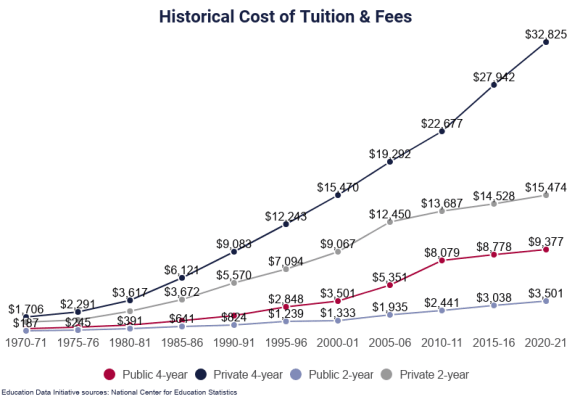
And it certainly pays to be wise with the spiralling costs of higher education.

The Education Data Initiative found the average cost of college in the United States is $35,551 per student per year, including books, supplies, and daily living expenses. Which means the average cost of college has more than doubled in the 21st century, with an annual growth rate of 7.1%.

So, this thought is a mash of a few areas:

1) The disconnection of degrees.

2) Why more courses, accreditations and degrees aren’t the only answer for development (and I say most, as doctors, psychiatrists, lawyers etc need these for safety reasons). 

3) Societies’ fixation on a model more linked to social status than one of benefit in a fast-paced and continuously adaptable environment.

Safe to say, these thoughts might get entangled. 

But, I hope I can at least provide some value and even a bit of reflection on the way our world views the process of growth today.

Anyway, let’s get to it, shall we?

Growth never ends

I’ve always found the notion of people believing growth and learning stop after formal education quite comical.

As if on one particular day, we decide that this is it. I’ve done all my learning now so I now need to never do such a thing again and should be awarded all the riches of life in accordance with the education I have received so far.

Usually, this happens when one completes their higher education studies in their mid-lateish 20’s. But it can happen at any time in our lifecycle.

We could look at this as finite thinking in what is mostly an infinite game. This is something I focused on a lot in my book on thriving and surviving a career in the 9-5.

Now, before we continue, I want to note that I’m not knocking the pursuit of formal education or degrees. For many, this is the right path and one that serves well. My goal here is to highlight the misconceptions of what this route can provide and what some people feel they are owed from it.

A degree is not a guarantee of anything or a debt that society owes any of us. It is, in many areas, what I like to call a ticket to the show.

In some way or another, my whole career has been connected with workplace people development in its now 16-year span. This has given me the wonderful and unique opportunity to meet brilliant people from all walks of life.

One commonality I have found amongst my connections with fellow humans is the way society has programmed us to look at educating ourselves and the status we are owed if we achieve x,y and z.

The words education, learning, and my most hated word of training are loathed by so many of us because of the experiences and untold amounts of pressure and stress that are placed upon us in our younger years to attain a certain level within a commonly agreed-upon system.

I meet many (including myself at one point) who breathe a sigh of relief when they leave any education system and enter the world of work.

Why? Because they no longer have to conform to an experience that does not serve them and forces them to do something which yields little enjoyment and sometimes value.

And that’s a shame, as the real shocker is that we don’t stop learning, ever!

The known international education systems today are not where learning and growth end. They’re merely a chapter in our story. And, like the wise Albert Einstein said “Intellectual growth should commence at birth and cease only at death.” 

This is why I tend to find many are reluctant to engage in any form of workplace development that mirrors anything like education, learning or training in our minds. We’ve already formed a pretty divided opinion on those experiences before we set foot in the door.

Social learning, mentoring and coaching are popular methods of growth that haven’t been tainted with the experience of formal education. Even though all lead to the same outcome – our improved development as humans.

So, because of the bad rep education gets, in whatever context you view it, people tend to see their time served within these systems as some sort of badge they wave at the entrance of employers and social events to guarantee their status in society.

The funny thing is that life has other ideas.

One life, multiple careers

We live in an area of the multi-career.

Many of us will change what we do several times during our lifespan. Opportunities to diversify and build new skills and behaviours have never been more accessible. We also have more of us than ever shunning what is viewed as “typical careers”. 

Instead, we focus on becoming social media stars, gaming streamers and content creators in all forms.

It has never been more popular to not have a defined career. The non-obvious path has become obvious.

And you know what? That’s ok.

Our world is fast-paced, high delivery and full of pivot points where we need to adapt. Sadly our education system is not.

So still telling people that you have a degree in philosophy with a master’s in this and went to this university when you’re in your 40s as some kind of validation as to why you should be given a new role or promotion is not going to fly.

Today, what we need most are those who understand the skill of intentional and continuous learning.

A ticket + hard work = 🌟

As I said before, a degree is a ticket to the show. We need to continue to do the hard work and become the star of it.

On some levels what I’m saying here is that we can do better as a society in setting this up as the norm and making it part of the conversation when we talk about education in all forms.

Learning is an everyday behaviour and one we’re all engaged with more than we realise. And yes, learning can be fun too. It doesn’t need to involve classrooms, textbooks or stupid assignments. It can be over walks or a coffee conversation between others.

Anyway, what’s my point here? 

Perhaps, my focus is on us to not put all our eggs in one basket and reject continuous growth (I get I’m probably preaching to the choir with most reading this).

Perhaps, it’s also recognising that a degree doesn’t equal an advantage or a divine right in the game of careers. It’s a ticket to the show but you still gotta put in the work.

Here’s a little story for you before we depart for the rest of our day.

Many years ago, I worked with a company that recruited 100 fresh graduates a year on a 2-year rotational scheme. Each had a degree. and even a master’s in some cases.

They had done what society told them to do. Get a degree and increase your earning potential. This is somewhat true depending on your profession. 

Anyway, about those grads, how many do you think remained after the 2-year programme completion?

Go on…throw a number out there.

The answer is that 5% made it. Yes, really, only 5% were left after all was said and done. 

And why was this?

Because a degree alone is not enough to succeed. 

We need the full package. Adaptability, resilience, a thirst for continuous learning and the motivation to make things happen.

You may be done with school. But you can-and should-see the rest of your life as an education.

Bill Gates, Microsoft Founder

These are the traits I’ve seen in people who have become high performers in their domain by the measurement they use to define such success. No matter if they have a degree or not.

I tend to believe that if we focus less on one-time activities and hacks or quick routes, we’ll recognise everything we do is about moving forward and getting a little better. Day by day, challenge by challenge.

This feels like a good place for us to end, friend. I hope my non-obvious thinking might spark something in you.

Let me know your thoughts in the comments 👇

Before you go… 👋

If you like my writing and think “Hey, I’d like to hear more of what this guy has to say” then you’re in luck.

You can join me every Tuesday morning for more tools, templates and insights for the modern L&D pro in my weekly newsletter.